AFGHANITE
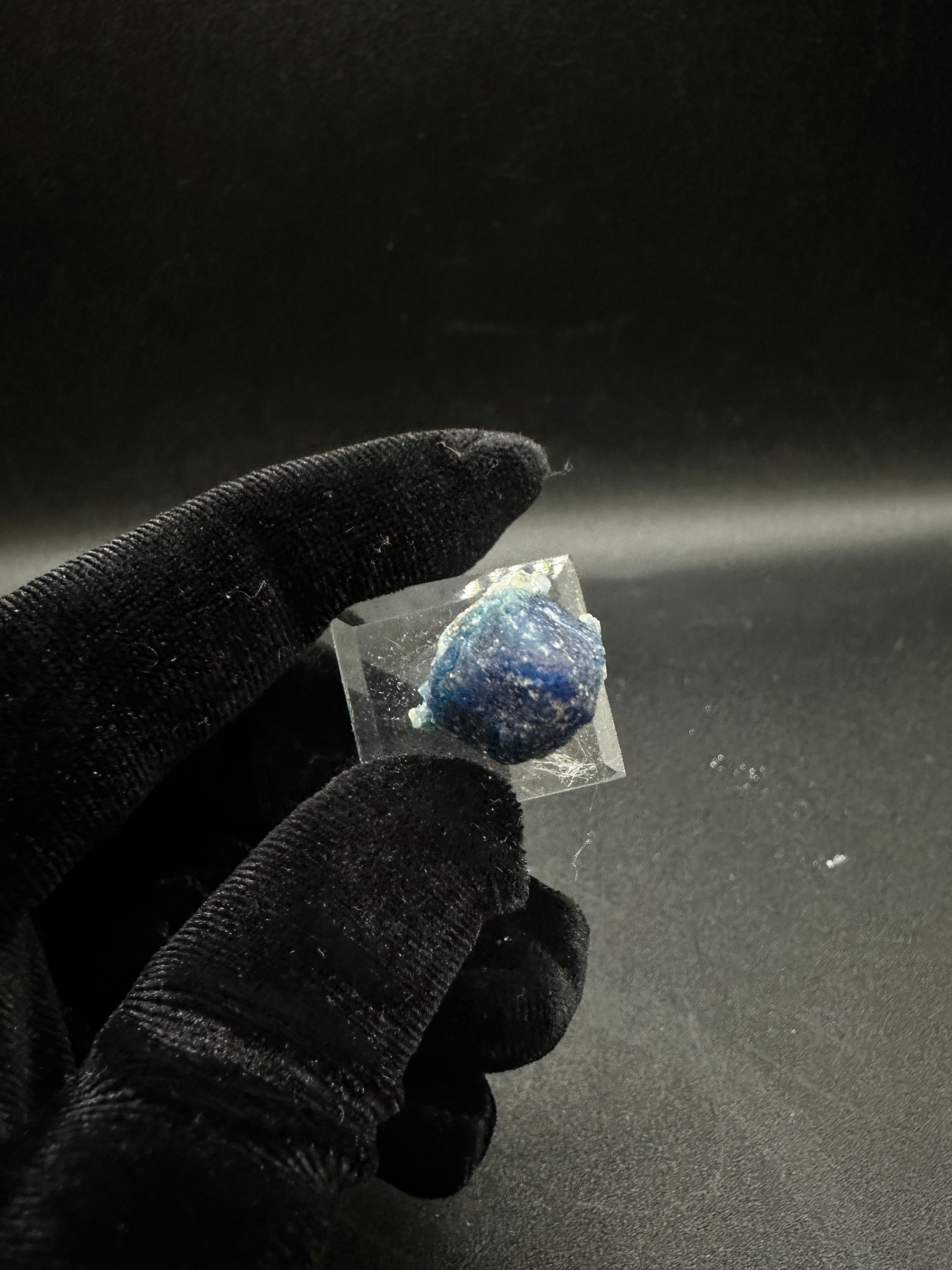
Afghanite Crystal Fully Terminated Deep Blue Indigo Natural Mineral Specimen
Afghanite Crystal Fully Terminated Deep Blue Indigo Natural Mineral Specimen
Description
Description
There are very few minerals on Earth that can stop you cold the moment you lay eyes on them — Afghanite from Sar-e-Sang, Afghanistan is absolutely one of them, a fully terminated hexagonal prism of inky, cobalt-to-indigo blue that looks less like a rock and more like something carved from a midnight sky. This locality is the only place on the planet where display-quality Afghanite crystals of this character are found, making every single piece a genuine rarity in the truest mineralogical sense. Read more below to discover how this beautiful crystal formed in the Earth as well as the metaphysical qualities of the stone. The crystal was displayed with "thumb tack" putty for photography ... the same stuff that your 4th grade teacher stuck papers to the wall with. There is no trace of the non toxic putty left on the crystal when it ships to you. Authenticity guaranteed.
- Locality: Sar-e-Sang, Kuran wa Munjan District, Badakhshan Province, Afghanistan
🙌 Afghanite Metaphysical Vibrations
Afghanite carries a profoundly still and wise energy — the kind that settles over you like a deep exhale, anchoring you to your highest truth while simultaneously opening the upper chakras to receive insight and clarity. It resonates most powerfully with the Third Eye and Throat chakras, supporting clear inner vision, honest communication and a deeper trust in your own knowing.
🌏 Geology of Afghanite from Sar-e-Sang, Badakhshan, Afghanistan
Tucked deep in the Hindu Kush mountain range of northeastern Afghanistan, the Sar-e-Sang district of Badakhshan Province is one of the most geologically extraordinary localities on the face of the Earth — a place humans have been mining and marveling at for more than 10,000 years. The rocks here belong to the ancient Sakhi Formation of the Archean Sanglich Group, among the oldest geological terranes in the entire region, and they preserve a record of tremendous heat, pressure and fluid activity that unfolded over hundreds of millions of years. Afghanite forms in a very specific and rare geological environment known as a contact metasomatic zone, where hot, mineral-rich fluids driven by deep igneous activity infiltrated and chemically transformed ancient limestone and carbonate-rich rocks over immense spans of time. This process, called metasomatism, essentially rewrites the chemistry of the host rock entirely — introducing sodium, calcium, potassium, aluminum, sulfur and chlorine into the system, the very ingredients that ultimately crystallize into the mineral we call Afghanite. The result is a complex alumino-silicate belonging to the prestigious cancrinite group of feldspathoid minerals, and what makes Sar-e-Sang so singular is that the precise combination of temperature, pressure, fluid chemistry and host rock composition that produced gem-quality, well-formed Afghanite crystals has essentially never been replicated anywhere else on Earth to the same spectacular degree. The same metasomatic system also gave rise to the legendary lapis lazuli deposits of Sar-e-Sang — the very lapis lazuli that adorned the funeral mask of Tutankhamun and was transported across continents in the Neolithic period — making this valley a place where ancient geology and ancient human history are permanently intertwined. Fully terminated Afghanite crystals like this one are exceptionally rare even within the deposit, as the long, prismatic hexagonal form requires undisturbed growth conditions across many millions of years in a cavity or pocket environment where the crystal faces and apex could develop freely. Afghanite was formally described and named as a new mineral species in 1968 by French mineralogists Bariand, Cesbron and Giraud, though specimens had been collected even earlier, and its structural complexity — as an eight-layer member of the cancrinite group — continues to be a subject of active crystallographic research. The deep, saturated blue that defines this mineral is produced by the same fundamental chemistry of the cancrinite-sodalite structural family interacting with sulfur-bearing cage structures within the crystal lattice, an optical property that has no perfect parallel in any other mineral from any other place.
Couldn't load pickup availability
Share